
When commissioning a Re-Engineered Classic™, few decisions influence the driving experience more than the engine beneath the hood. Two of the most respected V8 platforms in modern performance are Ford's Coyote and GM's LS. Both offer exceptional reliability, power, and aftermarket support, but they deliver that performance in distinctly different ways
The question isn't necessarily which engine is better. It's which engine best aligns with how you want your vehicle to feel every time you get behind the wheel.
Coyote vs. LS Engine Architecture
First some background. Ford introduced the Coyote V8 in 2011 and has used the naturally aspirated engine for versions of the Mustang and F-150 pickup. With a dual-overhead-camshaft design, the Coyote can rev high – very high.
Displacement is 5.0L and output has grown from 420 hp when the motor first hit the streets to 480 hp in its latest and most potent iteration.
The LS engine extended the legendary Chevy small-block V8 into the modern era, first appearing in the fifth-generation Corvette, produced from 1997-2004.
On paper, it’s a less advanced naturally aspirated design than the Coyote, and it lacks the Ford engine’s high-revving capabilities. But it is still plenty powerful, ranging in displacement from 4.8L to 7.0L and pumping anywhere from less than 300 hp to more than 600 hp from a tried-and-true pushrod design.
While specifications tell part of the story, horsepower figures and displacement numbers rarely determine how a vehicle feels on the road. The real distinction between the Coyote and LS becomes apparent in how they deliver power and shape the driving experience.
Different Ways of Delivering Power
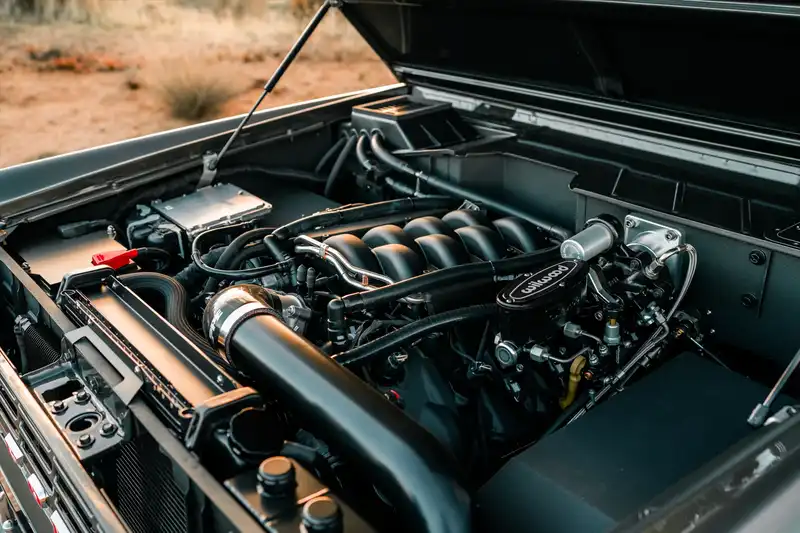 The Coyote feels modern and rev-happy.
The right choice depends on the experience you're looking to create. Drivers who appreciate a modern performance often gravitate toward the Coyote's willingness to rev and its broad power band. Those who prefer immediate torque and a more traditional V8 character frequently favor the LS. Neither is objectively better. Each delivers a distinct personality behind the wheel.
For many buyers, selecting an engine is less about specifications and more about defining the character of their vehicle. It's one of the decisions that transforms a classic vehicle into a truly personalized driving experience.
The Coyote vs. LS choice also becomes important when determining the best V8 for a classic truck. While both engines deliver impressive performance, the right choice depends on how you intend to use the vehicle and the driving experience you want to create.
How Velocity Approaches Engine Selection
While enthusiasts often debate Coyote vs. LS, Velocity takes a platform-specific approach. Our Ford builds are powered by the Gen 4X Ford Coyote 5.0L V8, while our Chevrolet builds utilize GM's modern LT-based V8 platform. We select powertrains that best complement the vehicle's heritage while delivering the reliability, drivability, and performance expected from a modern vehicle.
Reliability Is Not An Issue for the Ford Coyote vs. the Chevy LS
Because both engines have been in production for many years, they’ve had the chance to prove themselves in new vehicles from Ford and GM and as “crate” motors that can be purchased on their own.
The LS draws on the legacy of Chevy’s small-block engines – the pushrod design is considered old-fashioned by some engineers, but what it lacks in 21st-century tech it more than makes up for in reliability. GM has been building the engine for decades, and mechanics know it inside and out.
The Coyote is more complicated, but the technologies it contains are not very radical by the standards of the modern auto industry. It handles airflow and combustion more efficiently than the LS and, as V8s go, offers higher MPGs.
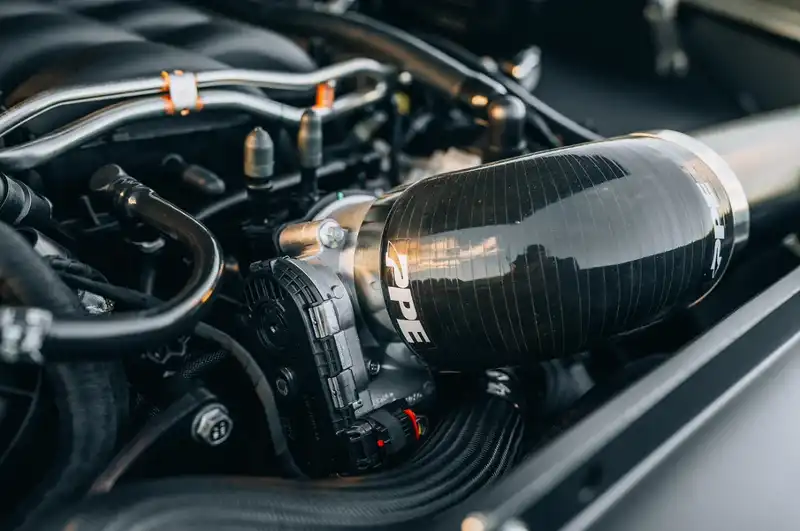 Coyote engines improve on airflow, throttle response, and engine sound.
At Velocity, engine reliability is only part of the equation. A dependable powertrain must be paired with modern cooling systems, electronics, suspension, braking, and chassis engineering to deliver the confidence expected from a modern vehicle. That's what ultimately separates a collection of parts from a fully re-engineered driving experience.
Packaging the Coyote and LS for Restomods
Integrating a modern powertrain into a classic vehicle involves far more than simply fitting an engine into an engine bay. Engine placement, cooling, electronics, driveline geometry, and chassis tuning all influence how the finished vehicle performs and feels on the road.
The Coyote is more difficult to drop in, but builders have figured it out. At Velocity, every powertrain is integrated as part of a complete engineering process. Ford builds utilize the Gen 4X Coyote platform, while Chevrolet builds are powered by modern LT1 V8s. In both cases, the engine is only one component of a larger system that includes cooling, electronics, chassis engineering, suspension tuning, braking performance, and driveline integration. Every system is designed to work together, ensuring the powertrain complements the vehicle’s chassis, suspension, braking, and driving dynamics.
Choosing the Right Engine for Your Project
The LS has earned a reputation as one of the most versatile and widely supported performance V8 platforms available. Its extensive aftermarket ecosystem and straightforward packaging have made it a popular choice for performance-oriented builds across a wide range of vehicle platforms.
The platform's maturity also gives builders significant flexibility when tailoring performance characteristics to a specific vehicle and driving style. So if your restomod plan involves upping the power and performance by going that route, the LS provides more room to maneuver.
At this point, LS is probably still the swap motor that most restomod builders will consider first. But some customers do prefer the performance characteristics of the Coyote engine for a restomod, so the Ford V8 is gaining popularity for swaps.
The Coyote has 15 years of production behind it, as well, so locating used versions and parts is less tricky for builders. However, it does get along better with Ford vehicles. Dropping one into a non-Ford car or truck can be done, but it requires some extra work.
What Buyers Are Best Suited for the Coyote vs. LS
For buyers evaluating the best V8 for a classic truck, there is no universal answer. The LS and Coyote each offer distinct advantages. What matters most is how well the powertrain is integrated into the vehicle as a complete system
While every driver is different, certain preferences naturally align with each platform. Buyers seeking effortless low-end torque and a more traditional V8 feel often appreciate the LS. Those who enjoy a more contemporary performance character and high-revving power delivery frequently gravitate toward the Coyote.
Both engines are equally comfortable carving corners or handling everyday driving duties. The Coyote distinguishes itself with a high-revving personality, delivering its most memorable moments as the tachometer sweeps past 7,000 rpm and its unmistakable exhaust note takes center stage.
 The Coyote rewards high revs with a scream that comes alive past 7,000 rpm.
Ultimately, both engines have earned their place among the most respected V8 platforms in modern performance. The right choice depends on the driving experience you value most.
Whether powered by a Ford Coyote, a Chevrolet LS, or a modern LT platform, the engine is only part of what defines a great restomod. At Velocity, every Re-Engineered Classic is designed as a complete vehicle system, where the powertrain, chassis, suspension, braking, and electronics are engineered to work together. The result is a vehicle that delivers contemporary confidence while preserving the character that made the original iconic.
The engine may shape the personality of the drive, but the engineering behind the entire vehicle is what defines the experience.
Leave a Comment
This policy contains information about your privacy. By posting, you are declaring that you understand this policy:
This policy is subject to change at any time and without notice.
These terms and conditions contain rules about posting comments. By submitting a comment, you agree with these rules:
Failure to comply with these rules may result in being banned from submitting further comments.
These terms and conditions are subject to change at any time and without notice.
Comments